
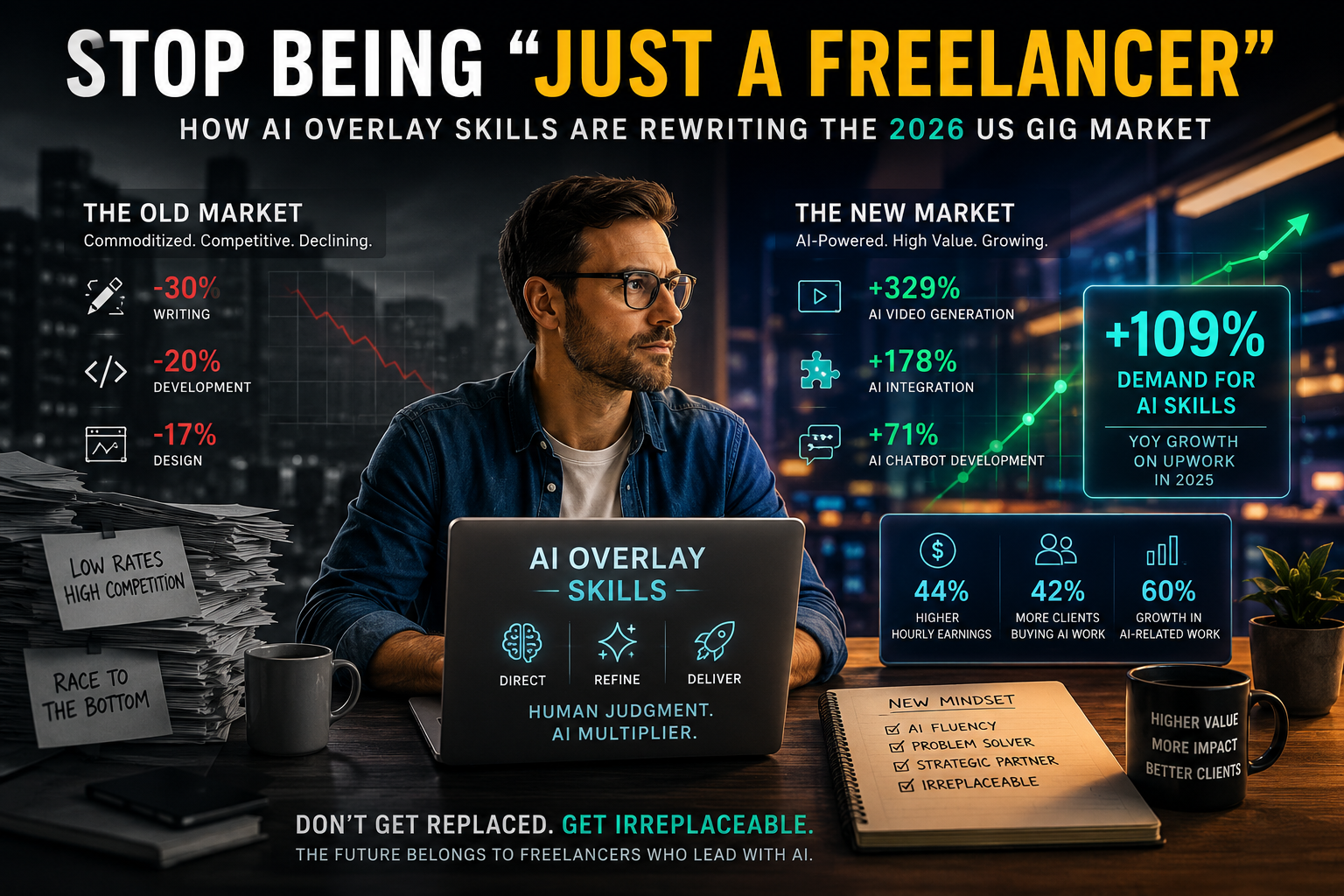
Stop Being "Just a Freelancer": How AI Overlay Skills Are Rewriting the 2026 US Gig Marketing
You've heard this story before. AI is coming for freelance work. Rates are collapsing. The smart move is to panic quietly while updating your LinkedIn headline. There's another version too, the one agencies love to repeat at conferences, where AI is pure upside, a magic multiplier turning every freelancer into a one-person unicorn.
Both versions lie by omission. The real story playing out across the US independent workforce in 2026 isn't growth. It isn't collapse either. It's a split.
Look at what actually happened in the eight months after ChatGPT went mainstream. Researchers at Harvard and Imperial College London tracked freelance job postings across 61 countries. Work most exposed to automation didn't grow more slowly. It shrank outright. Postings for writing work fell more than 30%, software and app development dropped over 20%, and graphic design slid by roughly 17%. Brookings, working with separate platform data, found that freelancers in AI-exposed occupations saw contract volume drop by about 2% and earnings fall by roughly 5%.
That's not a rounding error. That's the floor of the freelance market quietly giving way under people who kept doing the same work the same way while the ground shifted beneath them.
Now put that next to what Upwork published in its sixth annual In-Demand Skills report, released February 4, 2026. The headline number: demand for skills explicitly tied to AI grew 109% year over year, based on real completed-project earnings across the platform's US marketplace throughout 2025. But the detail that matters more than the headline is this. The traditional skill categories didn't disappear. Full-stack development, web design, data analytics, social media marketing and graphic design remained the highest-volume categories on the platform.
What changed is what's happening inside those categories. An AI-flavored variant started pulling away from the pack in earnings growth: AI video generation and editing up 329%, AI integration up 178%, AI data annotation and labeling up 154%, AI chatbot development up 71%. Dr. Gabby Burlacu, senior research manager at Upwork, put it plainly in the report: professionals who can direct and refine AI output, rather than compete with it, are the ones standing out.
This is the shape of the split. The same freelance market punishing commodity writers and generic designers is simultaneously paying a premium to people doing recognizably similar work, just wrapped in a different skill set and a different story.
Two Economies, One Login Page
Forget "AI's impact on freelancing." Think of it as two separate labor markets sharing a login page.
In one, a freelancer sells a service AI can approximate well enough that the client stops paying for the human version. Generic blog posts. Template logos. Boilerplate landing pages. That market is visibly contracting, and the Harvard and Imperial College data on falling postings is the clearest proof we have that this isn't anecdotal.
In the other market, freelancers get hired precisely because they operate AI tools with judgment the client doesn't have in-house. Upwork's numbers confirm it from the earnings side. Freelancers working on AI-related projects earned roughly 44% more per hour than freelancers who didn't touch AI work at all. AI-related work on the platform grew 60% year over year. The number of clients purchasing AI-related projects rose 42%. By the end of 2025, work tagged as AI-related had reportedly crossed into hundreds of millions of dollars in annualized value on Upwork alone.
Here's the uncomfortable part. Most freelancers believe they're standing in the second market when they're actually stuck in the first. They added "AI" somewhere in their profile bio without restructuring what they actually sell. Upwork's Research Institute surveyed qualified freelancers and found that 31% now describe themselves as AI-enabled, and 54% rate their own AI skills as advanced or expert.
That's a lot of self-identification. Whether it translates into pricing power depends entirely on whether the freelancer changed the offer itself, not just the label stapled onto it.
What "Overlay" Actually Means
"AI overlay skill" sounds like consultant-speak. Let's make it concrete.
An overlay skill isn't a new job category. It's an existing skill, copywriting, video editing, backend development, virtual assistance, with AI fluency layered on top so the freelancer produces more, faster, or at a level of polish that wasn't previously possible at that price point. Dr. Teng Liu, an economist at Upwork, framed the mechanism well: human-AI collaboration on the platform has been shown to boost project completion by up to 70%, even on relatively simple tasks.
AI doesn't replace the freelancer's judgment. Judgment, applied at higher speed and paired with AI execution, becomes the actual product being sold.
This is different from the "AI-only" jobs that get breathless headlines. The prompt engineer with no other domain expertise. The "AI consultant" whose entire pitch is that they know ChatGPT exists. Those roles exist and can pay well; entry-level prompt engineering work on freelance platforms runs somewhere between $50 and $100 an hour, climbing to $175 to $300 for freelancers with three or more years of applied experience, and up to $250 to $500 an hour for specialists in regulated fields like healthcare, legal or finance.
But the more durable opportunity, the one most freelancers can capture immediately, is the overlay. Take a skill you already sell. Rebuild the offer around AI-assisted execution instead of trying to become a generic "AI person" from scratch.
Where the Premium Actually Sits
Sort through Upwork's 2026 data category by category and a pattern emerges that matters more than the overall 109% headline.
In coding and web development, AI integration work, connecting AI tools and APIs into a business's existing software stack using platforms like n8n, Make and Zapier, grew 178%. It's now one of the fastest-growing line items freelancers can bill for. In design and creative work, AI video generation and editing is the single fastest-growing skill on the entire platform at 329% growth, driven by brands and agencies wanting AI-assisted video at a volume and price point traditional production couldn't touch. Data annotation and labeling, unglamorous as it sounds, grew 154% because every company training or fine-tuning a model needs humans to structure the data first. AI chatbot development, building customer-facing assistants for small and mid-sized businesses using tools like Claude and custom GPT-based agents, grew 71%.
None of these are entirely new professions. They're existing categories, video editing, backend integration, data work, customer support tooling, with an AI layer changing both what's deliverable and what a client is willing to pay for it.
A freelance automation consultant working independently in the US typically bills somewhere between $75 and $150 an hour for AI workflow implementation. Boutique consulting operations charging for the same category of work often land between $150 and $350 an hour, according to 2026 rate benchmarking. Retainer arrangements for ongoing AI implementation support commonly run $5,000 to $15,000 a month. Against a broader freelance market where the median hourly rate across roughly two dozen US service professions sits around $105, the AI-adjacent premium is real. It's not marginal.
The Repositioning Playbook
The freelancers navigating this well aren't inventing new careers. They're renaming and restructuring the ones they already had.
One frequently cited case: a copywriter billing $45 an hour for standard content work repositioned as an "AI content strategy consultant." Same underlying writing and editing skill, sold as a strategic service built around directing AI tools rather than typing every word manually. The rate moved to $125 an hour. Another case involves a UK-based copywriter who began offering "AI-assisted blog systems" to SaaS companies instead of per-post writing, and tripled per-project pricing within three months, while staying upfront with clients about where AI fit into the process. A marketing freelancer who used to offer generic social media management instead built a narrow, AI-supported content system specifically for real estate agents, trading breadth for specialization and pricing accordingly.
What connects these examples isn't a specific tool or platform. In each case, the freelancer stopped selling hours and started selling a system. AI handles the repetitive middle of the work while the human retains what a client can't get anywhere else: strategic framing, taste, quality control, accountability.
There's a rough rule of thumb circulating among freelancers who've made this shift work, sometimes called the 10-80-10 split. The freelancer does the first 10% of a project alone: direction, strategy, creative framing. The middle 80% goes to AI-assisted execution. The final 10% gets reclaimed for quality control and the distinctly human touches a client is actually paying to receive. Not a rigid formula. A useful mental model for figuring out where your value sits once AI can do the drafting.
Fractional Over Full-Time
There's a structural reason this shift is happening at the scale it is, and it has less to do with freelancers than with how US businesses choose to buy expertise.
In Upwork's survey of business leaders, 77% said AI is increasing their need for specialized, fractional talent rather than traditional full-time headcount. That finding lines up with a broader, well-documented trend. The global fractional executive market is now valued at roughly $5.7 billion, growing about 14% a year, and the number of fractional executives operating in the US is estimated to have roughly doubled between 2022 and 2024. Projections suggest 25% of American companies already use some form of fractional hiring, with that figure expected to climb toward 35% by the end of 2026. Gartner has forecast that more than 30% of mid-sized companies will have at least one fractional executive on board by 2027.
Read together, the fractional boom and the AI-overlay skills boom are the same story told from two different vantage points. Businesses don't want to hire a full department to get AI-literate work done, and they don't need to. A single freelancer fluent in both a domain and the AI tools that accelerate it can now credibly deliver what used to require a small team. That's exactly why nearly half of the business leaders Upwork surveyed said they'd pay a premium for independent talent bringing genuine creativity and innovation to the table, not just execution speed.
The freelancer who understands this isn't competing against AI. They're competing against the internal hire the client didn't want to make in the first place.
Standing Still Is the Risk
None of this happens in isolation from a broader shift in how the American labor market treats AI fluency generally.
McKinsey has tracked the number of US workers in occupations requiring AI fluency growing roughly sevenfold in two years, from about a million people in 2023 to around seven million by 2025. PwC's Global AI Jobs Barometer, drawn from close to a billion job postings, found that workers with AI skills commanded a wage premium of 56% in 2024, more than double the 25% premium recorded the year before. Boston Consulting Group projected in March 2026 that 50% to 55% of US jobs will be reshaped, not eliminated, by AI over the following two to three years.
Reshaped is the operative word. It implies the job survives in a different form, and the person who survives with it is the one who changed how they work before the market forced the issue.
That's the actual choice sitting in front of every US freelancer and independent professional right now. Not a choice between panicking about AI or ignoring it. A choice between staying inside the shrinking half of the market, the half Harvard and Imperial College researchers can already see contracting in the data, or deliberately restructuring your existing skill around AI-assisted delivery before a client makes that decision for you by simply not renewing the contract.
The freelancers pulling ahead in 2026 didn't become different people. They kept the expertise that made them worth hiring in the first place, and got serious about being the person who directs the AI instead of the person AI quietly replaced.